When a disaster strikes—like the devastating impact of Hurricane Helene in the mountains of Tennessee and North Carolina—infrastructure crumbles instantly. Cell towers go down, landlines fail, and standard internet communication vanishes.
Having a solid communication plan is essential not only for coordinating search and rescue operations, but for ensuring the basic survival of you and your family.
Whether you are navigating washed-out roads, checking on loved ones, or keeping tabs on local weather alerts, the General Mobile Radio Service (GMRS) offers one of the most accessible, powerful, and straightforward solutions for emergency preparedness.

What is GMRS?
GMRS stands for General Mobile Radio Service. It is a licensed radio service regulated by the FCC in the United States designed for reliable, short-to-medium-range two-way voice communications.
Unlike consumer radios you might pick up off the shelf at a big-box store, GMRS bridges the gap between simple toy walkie-talkies and complex amateur (ham) radio.
GMRS vs. FRS: What’s the Difference?
- FRS (Family Radio Service): These are the cheap, blister-pack radios you find at department stores. They operate at very low power levels (ranging from 0.5 watts to 2 watts) and do not require a license. However, their range is severely limited.
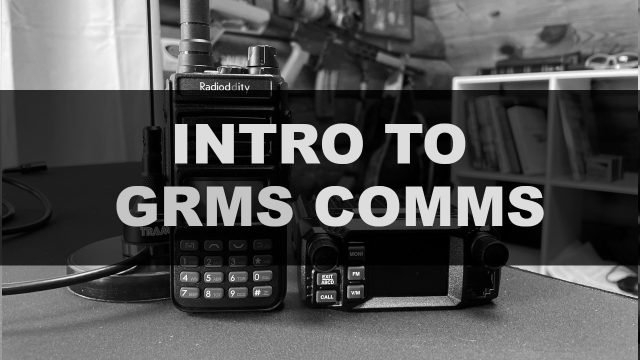
- GMRS: GMRS handheld units (like the popular Radioddity GM30 or various Baofeng models) typically transmit at 5 watts or higher, while mobile units mounted in vehicles can push 15 to 50 watts. Higher wattage means significantly greater distance, better penetration through terrain, and clearer signals.
Getting Licensed
The best part about GMRS? No test is required. You simply pay a $10 application fee to the FCC, and your license covers you and your entire immediate family for 10 years. It is arguably the best value in emergency preparedness licensing available.
Essential GMRS Terminology and Settings
If you are new to radios, the technical jargon can feel overwhelming. Here is a breakdown of the core terms you need to know to get up and running quickly in the field:
1. Squelch
Squelch is an adjustable setting on your radio that mutes background static when no transmission is coming through.
- Think of it like tuning an old analog television—the squelch knob acts as a gatekeeper for static.
- If you set your squelch too high, you might block out weak signals from someone deep in the mountains or behind heavy terrain.
- A standard everyday setting is usually around level 3, but if you are trying to pull in a faint, distant signal during an emergency, you may need to lower or temporarily turn off your squelch to listen closely.
2. Channel Mode vs. Frequency Mode
Most modern handheld GMRS radios feature two primary operating modes:
- Channel Mode (The Standard): This is where you spend 90% of your time. GMRS features 30 primary channels. Channels 1 through 22 are standard simplex channels used for direct radio-to-radio communication.
- Frequency Mode (VFO Mode): This mode allows you to punch exact frequencies directly into the keypad. While most GMRS radios won’t let you transmit outside of GMRS bands, many allow you to listen in to other frequencies. During an emergency, you can use frequency mode to monitor local fire, EMS, or NOAA weather broadcasts to stay informed of unfolding hazards.
3. CTCSS and DCS (Privacy Codes)
When you broadcast on a public channel like Channel 17, anyone else tuned to that channel can hear you. If you want to filter out background chatter and only hear (and be heard by) members of your own group, you use CTCSS (Continuous Tone-Coded Squelch System) or DCS (Digital-Coded Squelch).
- How it works: These are often called “privacy codes.” They don’t encrypt your voice or make your conversation secret to advanced listeners; instead, they act as an auditory key. Your radio sends an sub-audible tone alongside your voice that only opens the speakers of radios programmed with the exact same code.
4. NOAA Weather Radio Integration
Most GMRS radios come with built-in NOAA weather channels. In a crisis, scanning these channels is critical. During severe weather events, automated and live broadcasts provide life-saving updates—such as flash flood warnings, wind advisories, or potential dam-break alerts—giving you precious time to relocate to higher ground.
5. Repeaters (Extending Your Range)
While direct radio-to-radio (simplex) communication might only get you a few miles depending on terrain, repeaters change the game.
- GMRS channels 23 through 30 are designated repeater channels.
- A repeater is a high-powered base station (often placed on top of a mountain or tall tower) that receives your transmission on one frequency and instantly rebroadcasts it out on another at a much higher power.
- While a standard handheld radio might only reach 2 miles in hilly terrain, routing your transmission through a local repeater can easily stretch your effective communication range out to 50, 70, or even 100 miles depending on line-of-sight. You can easily look up active GMRS repeaters in your local area online before an emergency strikes.
6. Antennas
Keep it simple. While radio enthusiasts love building custom antennas, you can purchase pre-tuned, high-gain mobile or handheld antennas online for a very reasonable price (often under $30). Upgrading from a stock handheld antenna to a slightly larger dual-band whip antenna or mounting an external antenna to a vehicle or cabin roof will drastically improve your transmission clarity and reach.
Keep Your Plan Simple in the Field
When chaos erupts, complexity is the enemy of survival. You don’t want to be fumbling through complex menus or trying to recall advanced technical settings while under pressure.
Your emergency game plan should look like this:
- Pick a designated GMRS channel ahead of time with your family or group.
- Program matching privacy codes (CTCSS/DCS) onto all your radios so you aren’t interrupted by outside chatter.
- Test your gear before disaster strikes.
- Keep spare batteries or a way to recharge your units (such as vehicle chargers or solar power banks) close at hand.
Stay safe, keep your gear dialed in, and look out for upcoming tutorials on programming specific radios like the Radioddity GM30 and setting up a home base station.